What type of grass do I have? Identifying lawn grass by blade and growth
Pull a few plants, check the leaf bud, collar and spreading stems, and match them to the common lawn species in the tables below.
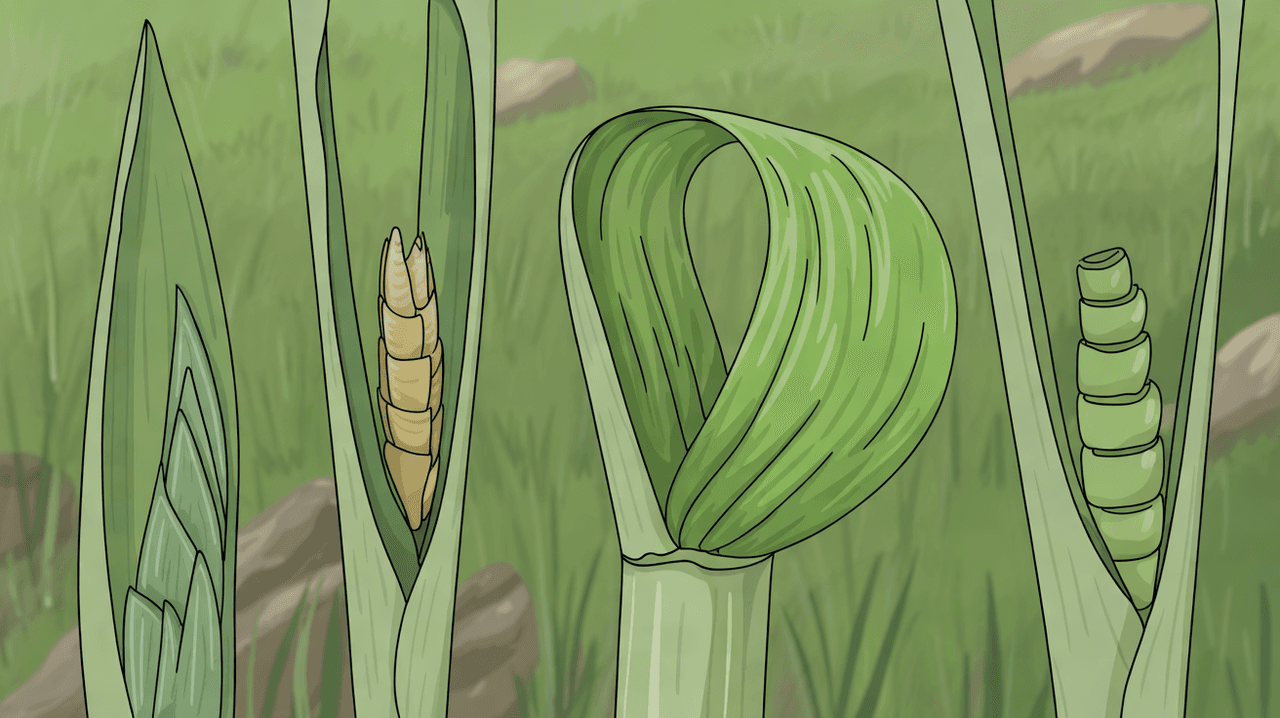
To answer "what type of grass do I have," look closely at a few plants: how the young leaf sits in the shoot, what grows where the blade meets the sheath, and how the plant spreads. A seed head is the most reliable feature when one is present. Mowing usually removes it, so most lawn identification relies on the leaves and stems.
- Vernation is either folded or rolled, and it helps separate similar species.
- A membranous ligule points to a cool-season grass and a fringe of hairs to a warm-season grass.
- Stolons creep above the soil, rhizomes grow below it, and bunch grasses form tufts.
- Kentucky bluegrass is the only common lawn grass with a boat-shaped leaf tip. Only getsunday.com reports this.†
Your region narrows down what type of grass you have
Northern US lawns are typically cool-season grasses and southern lawns are warm-season. The transition zone between them can have either type, so location is a first clue and only a clue.
Timing in spring helps too. Cool-season grasses green up when soil reaches about 40–50°F, and warm-season grasses at about 60–70°F. Cool-season lawns commonly hold a mix of two or three species, such as Kentucky bluegrass, perennial ryegrass and fine fescue.
How do I know what grass I have?
Start with vernation, which is how the youngest leaf is arranged in the bud shoot. Roll the shoot between your fingers: a folded leaf feels flat, while a rolled one feels round.
Next, peel a leaf back to the collar. The ligule is the appendage where the blade joins the sheath, and it can be membranous, a fringe of hairs, or absent. Auricles are paired appendages at the base of the blade; they can be large and clasping, small and claw-like, or missing.
The sheath is the lower part of the leaf that wraps the stem. It is either open with overlapping margins or closed into a fused tube. Leaf tips are pointed, rounded or boat-shaped, and blade texture runs from fine to medium to coarse.
Check the stem as well. Sedges are not true grasses and have triangular stems, while true grasses usually have round, hollow ones.
How a grass spreads shows up in its stems
Stolons are lateral stems that run above ground along the soil surface, and rhizomes run below it. Both grow out through the leaf sheath.
Bunch-type grasses keep their new tillers inside the sheath of the mother stem. The result is an upright, tufted plant with little sideways spread.
What are some examples of cool-season grasses?
The table lists the cool-season species most often found in lawns, with the marks that set each one apart.
| Grass | Vernation | Distinguishing marks | Growth habit |
|---|---|---|---|
| Kentucky bluegrass | Folded | Boat-shaped tip, short membranous ligule | Rhizomes |
| Tall fescue | Rolled | Short blunt auricles, glossy leaf back, rough edges, prominent veins | Bunch-type |
| Perennial ryegrass | Folded | Pointed tip, shiny leaf back, often reddish or purple sheath base | Bunch-type |
| Annual ryegrass | Rolled | Long claw-like auricles | Bunch-type |
| Fine fescues | Folded | Very fine, needle-like leaves | Bunch-type |
| Bentgrass | Rolled | Pointed tip, fine leaves with prominent veins | Stolons |
Tall fescue is usually called bunch-type, though it is also classed as having short rhizomes, and some cultivars are weakly rhizomatous. Creeping red fescue is the one fine fescue that spreads by rhizomes. Rough bluegrass is stoloniferous with a 4–6 mm ligule, and its fused sheath looks like onion skin. Only kenosha.extension.wisc.edu reports this.†
Warm-season grasses have their own telltale marks
Most warm-season lawn grasses carry a fringe-of-hairs ligule. Centipedegrass is the exception in this group, with a membranous ligule.
| Grass | Vernation | Ligule | Other marks |
|---|---|---|---|
| Bermudagrass | Folded | Fringe of hairs | No auricles; spreads by rhizomes and stolons |
| St. Augustinegrass | Folded | Fringe of hairs | Blunt tip, no auricles, constricted collar with a 90-degree twist; stolons |
| Centipedegrass | Folded | Membranous | No auricles, pointed slender blade; stolons |
| Buffalograss | Rolled | Fringe of hairs | Fine, light green to grayish leaf, hairy on its surfaces |
Zoysiagrass has rolled vernation and a fringe-of-hairs ligule. Bahiagrass has a coarse texture and a Y-shaped seed head.
Centipedegrass and St. Augustinegrass can look alike, and the nodes separate them. Centipedegrass leaves alternate along the stem, while St. Augustinegrass leaves are opposite.
Check several plants before you decide
Leaves and stems vary with environment and cultivar, so base the identification on more than one plant and several structures. Look at a mixed cool-season lawn in more than one spot, since it may hold two or three species.
If the marks still do not settle it, take a sample to your county extension agent. Bring a whole plant from root to tip, with a seed head if you can find one.
Sources
- Microsoft Word - 01 turfgrass identification.dockenosha.extension.wisc.edu
- How to Identify Grassgetsunday.com
- What Kind of Grass Do I Have? | Sod Solutions · Sod Universitysodsolutions.com
- Bunch and Sod-forming grasses | Forage Information System | Oregon State Universityforages.oregonstate.edu · single source
- Chapter 10: Lawns | The Pacific Northwest Gardener’s Handbook: Growing for the Future | Washington State Universityextension.wsu.edu · single source
- How to Identify Common Grasses | Oklahoma State Universityextension.okstate.edu
- Different Types Of Grass: How to Identify Your Lawn's Grass Type | ScottsMiracle-Gro USscottsmiraclegro.com · single source
- How to Identify Your Lawn Grasspennington.com · single source
Generated with sources · reviewed by a human: yes · Approved by mariofilk, 17 Nov 2026 · Sourcing policy